


Analysis
Inquiry.
A structured inquiry into how civilizations, institutions, technologies, ecologies, economies, cultures, and historical sequences interact across time — with explicit attention to source integrity, causal mechanisms, comparison validity, chronology, scale, uncertainty, selection effects, continuity versus rupture, misuse risk, and the limits of applying historical analogy to the present.
causal discipline,
not just story.
Civilizational analysis becomes rigorous when sources, scope, causal claims, comparison logic, chronology, and scale are made explicit rather than absorbed into a compelling narrative.
This genre examines source quality, multi-causality, mechanisms, counterfactuals, selection effects, comparative validity, chronology, micro-to-macro alignment, continuity and rupture, uncertainty, misuse risk, and the boundary between legitimate historical inference and misleading analogy.
that discipline historical inference.
These questions test whether civilizational claims are source-grounded, causally plausible, comparatively valid, chronologically precise, scale-aware, explicit about uncertainty, and responsibly bounded when applied to modern decisions.
Quality, provenance, bias, and limitations of primary sources and evidence chains.
Time period, geography, civilizational unit, and the boundaries of comparison.
Distinguish storytelling from tested causal inference.
How political, economic, ecological, technological, and cultural factors interact.
How exactly a proposed cause produces observed outcomes.
Whether claims are robust against plausible alternative explanations.
Which events, civilizations, or eras are included/excluded and why.
Whether comparisons are symmetric, fair, and structurally comparable.
Sequence integrity—what happened first, what followed, and why ordering matters.
Micro (individuals) vs meso (institutions) vs macro (civilization) claims are kept distinct.
Whether change is treated as gradual evolution or discontinuous shock—and justified.
How uncertainty is handled and where inference stops.
Civilizational narratives used to justify superiority, exclusion, fatalism, or deterministic policy.
Where historical patterns legitimately inform modern decisions vs where analogy becomes deception.
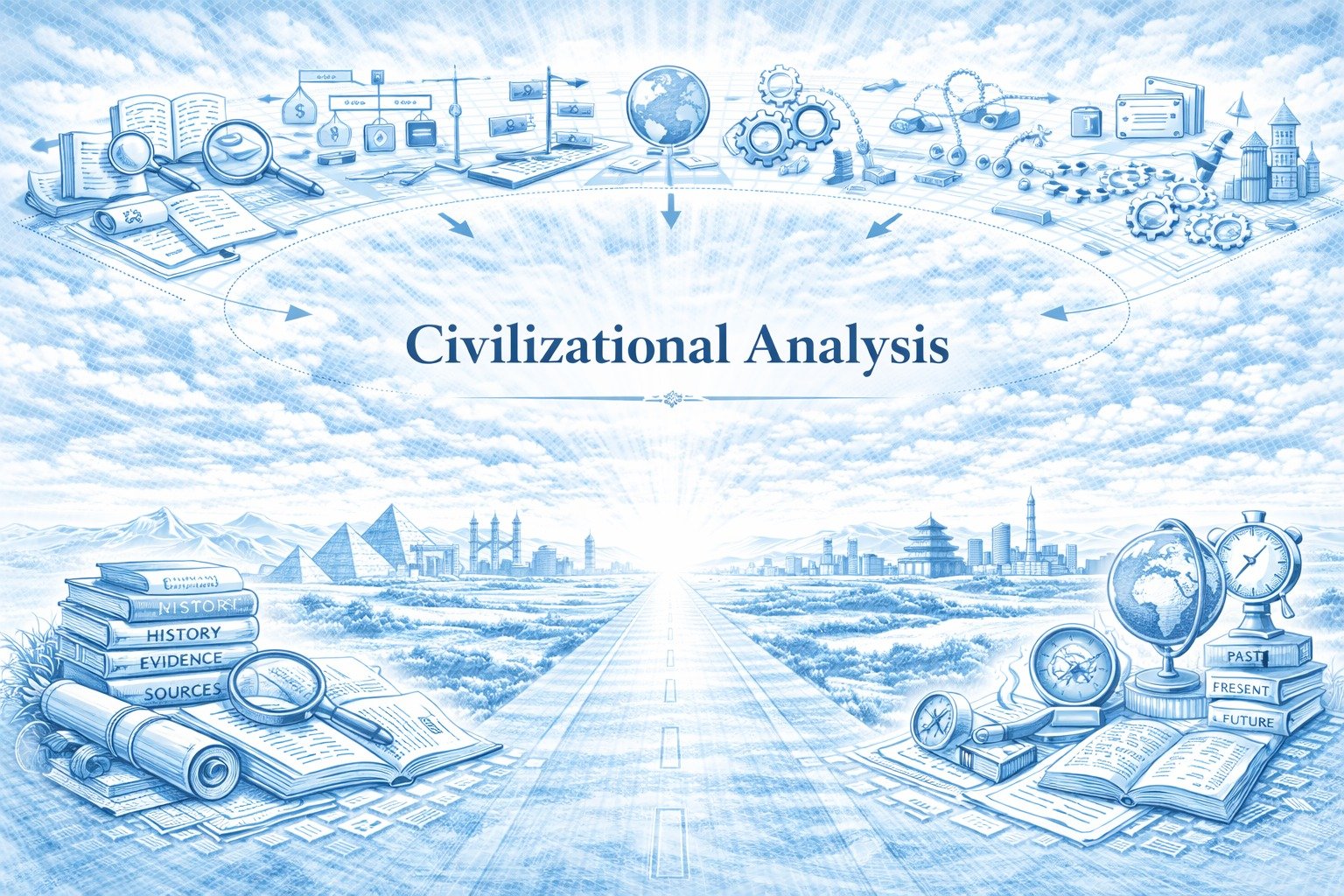
A visual grouping of this page’s civilizational-analysis questions — not a claim of a formal Nous Sapient model.
Establish evidence integrity, scope, chronology, selection logic, and the comparability of cases before drawing conclusions.
Test causal mechanisms, multi-causality, counterfactuals, scale, continuity versus rupture, and the limits of inference.
Use historical patterns cautiously, state uncertainty, resist deterministic narratives, and distinguish insight from misleading analogy.