


& Innovation
Systems.
A structured inquiry into how new ideas become viable ventures — examining problem validity, customer evidence, value proposition, hypothesis quality, learning velocity, experimentation, resource efficiency, scalability, market timing, team resilience, pivot discipline, and execution risk.
learning system,
not an idea.
Entrepreneurship turns uncertainty into evidence through disciplined discovery, experimentation, adaptation, and increasingly repeatable execution.
This genre examines whether the problem is real, whether users validate it, whether assumptions are explicit and testable, whether learning is fast enough, whether experiments are meaningful, whether resources are used efficiently, and whether the venture can scale without optimizing too early.
that turn ideas into evidence.
These questions test whether a venture is learning from reality quickly enough to move from an uncertain idea toward a repeatable, scalable, and resilient system.
Is the problem real, painful, and worth solving—or merely interesting?
Evidence that real users experience the problem as claimed.
Why the solution meaningfully improves the user’s situation.
Are assumptions explicit, testable, and prioritized by risk?
How quickly weak ideas are invalidated and strong signals amplified.
Do experiments actually test the riskiest assumptions?
Capital, time, and talent usage relative to learning gained.
How the idea moves from experiment to repeatable system.
Readiness of customers, ecosystem, and technology.
Ability to execute, learn, and adapt under stress.
Willingness to stop or pivot when evidence turns negative.
When and how exploration gives way to optimization.
Locking in before learning stabilizes.
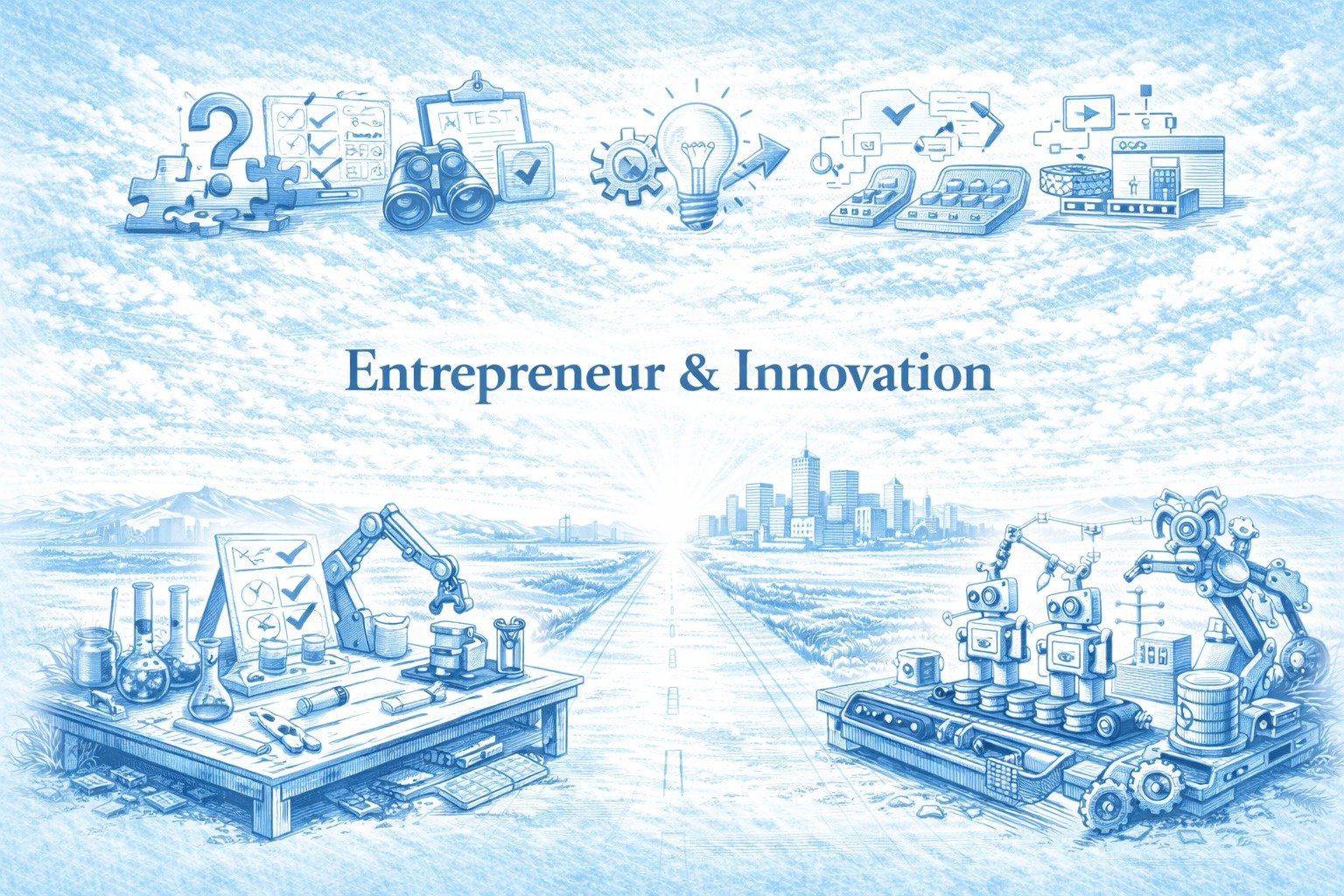
A visual grouping of this page’s entrepreneurship-and-innovation questions — not a claim of a formal Nous Sapient model.
Establish that the problem is real, the customer is understood, and the proposed value is meaningful.
Structure assumptions, run decisive experiments, learn quickly, and use resources in proportion to evidence gained.
Move from exploration toward repeatability while testing timing, team resilience, pivot discipline, and optimization risk.