


Continuity
& Resilience Architecture.
A structured framework for examining long-horizon continuity, existential and civilizational threats, irreversible pathways, deep uncertainty, governance feasibility, incentive realism, resilience, monitoring, and the translation of future-facing analysis into practical action.
designed capacity,
not an assumption.
Civilizational resilience asks how societies and systems can preserve continuity across time horizons far longer than normal political, commercial, or institutional planning cycles.
This genre examines time horizons, units of analysis, existential and civilizational threat pathways, causal mechanisms, irreversible lock-in, tail risks, deep uncertainty, scenario discipline, evidence quality, intergenerational ethics, governance, incentives, robustness, early warning, misuse risk, and practical decision architecture.
that structure the inquiry.
This genre examines how long-horizon systems are defined, threatened, protected, governed, monitored, and translated into decisions without treating speculative futures as certainty or sacrificing present legitimacy.
10, 50, 100, and 500-year frames are explicitly separated.
Humanity, civilization(s), institutions, ecological systems, and techno-systems are distinguished clearly.
Catalog of existential and civilizational degradation pathways, including ruin, collapse, and lock-in.
How do the proposed causal pathways operate, beyond metaphor or broad narrative?
Identify one-way doors, path dependence, value-lock, and infrastructure lock-in.
How are fat tails, unknown unknowns, and discontinuities handled?
Risk, deep uncertainty, and ignorance are distinguished and handled differently.
Scenarios are treated as bounded explorations, not predictions.
What is historical inference, what is model-derived, and what remains speculative?
Intergenerational ethics, value assumptions, and discounting stance are made explicit.
Can institutions sustain long-horizon commitments without authoritarian drift?
Why would current actors invest in long-horizon goods, and how is free-riding handled?
Prefer strategies that survive model error, uncertainty, and surprise.
What sentinel signals reveal slow-burn degradation and fast shocks?
Doomism, techno-utopianism, and coercive policies justified by "the future."
Clear levers, constraints, and staged interventions, not merely a worldview.
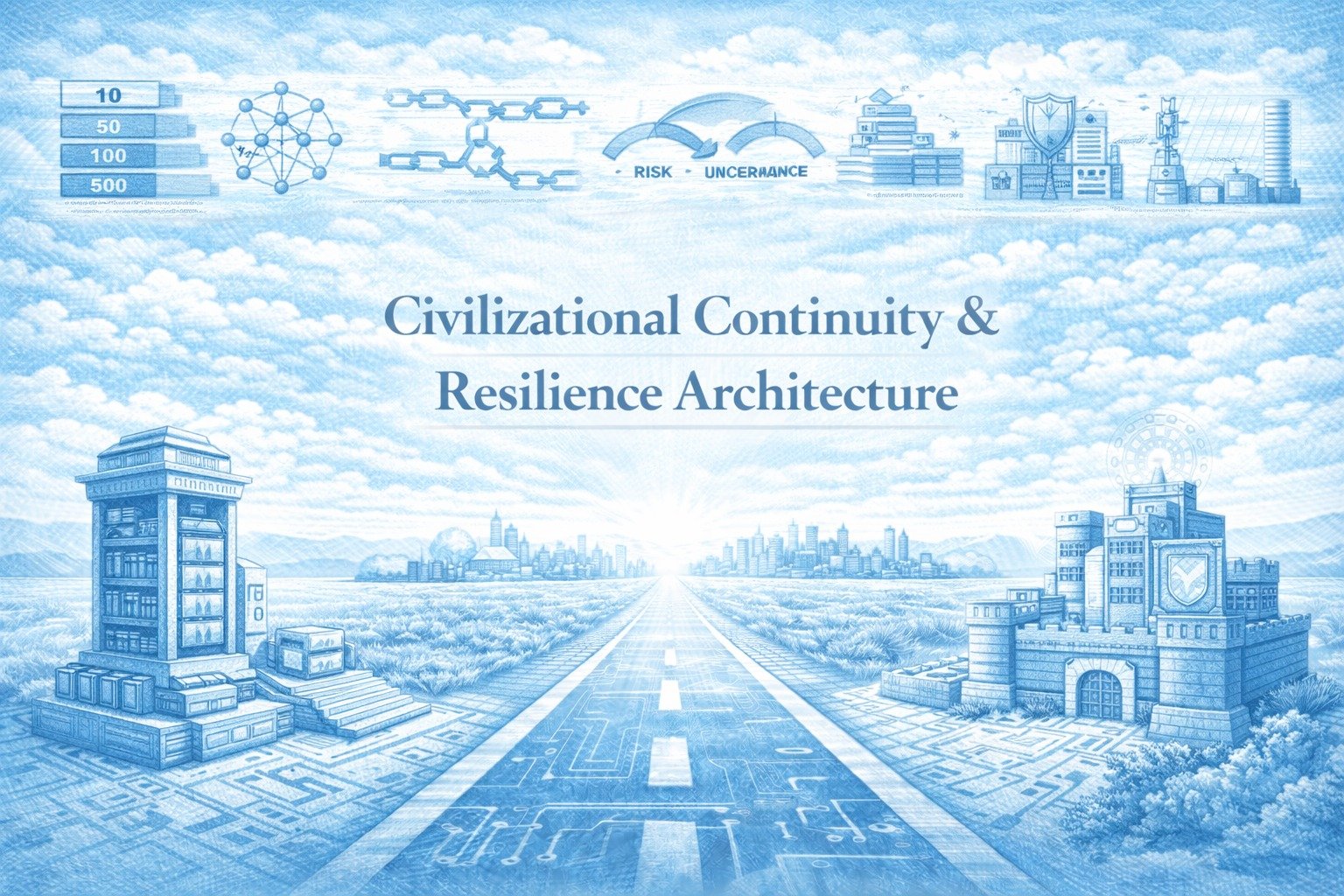
A visual read of how this genre moves from defining the long-horizon system and its threat landscape, through the design of resilient responses, to monitoring and action capable of preserving continuity under uncertainty.
Define the time frame, unit of analysis, threat pathways, irreversible conditions, uncertainty, and evidential limits.
Build governance, incentives, robust strategies, and safeguards that can endure model error, shocks, and deep uncertainty.
Monitor early-warning signals, constrain misuse, and translate long-horizon reasoning into staged, legitimate action.