


Making
Under Uncertainty.
A structured framework for evaluating uncertainty, consequences, evidence, decision quality, timing, trade-offs, and the discipline required to act when outcomes cannot be known in advance.
come from better
learning.
Risk and decision-making concern the quality of action under uncertainty: what is known, what is assumed, what must be tested, and when a decision should change.
This genre focuses on problem validity, customer evidence, value, hypotheses, learning velocity, experiment design, resource efficiency, scalability, timing, team resilience, failure recognition, execution, and the risk of optimizing before learning has stabilized.
that reduce avoidable risk.
The framework tests whether decisions are grounded in evidence, whether uncertainty is being reduced efficiently, and whether the organization knows when to continue, pivot, stop, or execute.
Is the problem real, painful, and worth solving, or merely interesting?
Does evidence show that users experience the problem as claimed?
Why does the solution meaningfully improve the user's situation?
Are assumptions explicit, testable, and prioritized by risk?
How quickly are weak ideas invalidated and strong signals amplified?
Do experiments actually test the riskiest assumptions?
How do capital, time, and talent usage compare with learning gained?
How does an idea move from experiment to repeatable system?
How ready are customers, ecosystem, and technology?
Can the team execute, learn, and adapt under stress?
Is there willingness to stop or pivot when evidence turns negative?
When and how does exploration give way to optimization?
Is the organization locking in before learning stabilizes?
Are actions matched to evidence, uncertainty, timing, and consequence?
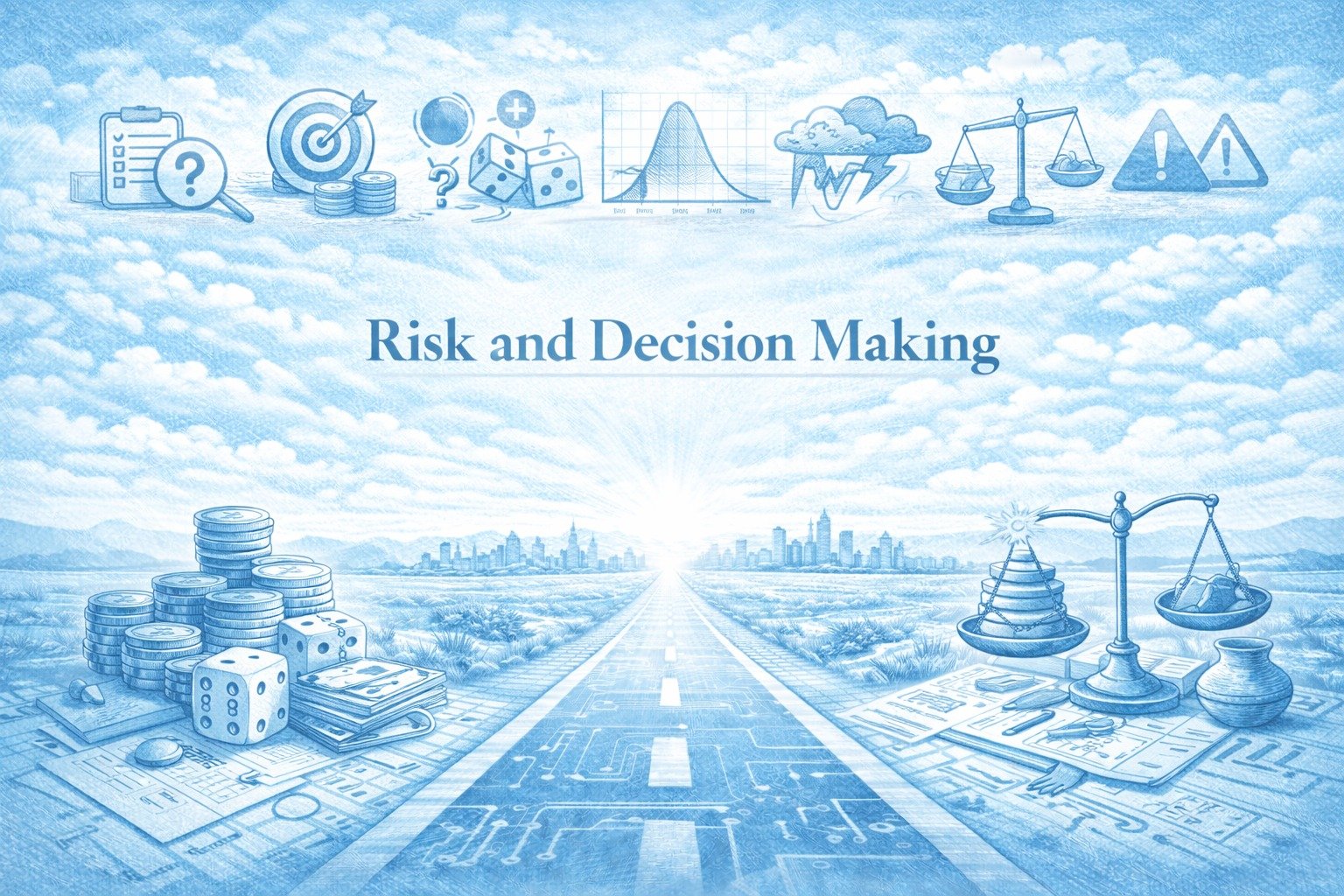
A visual read of how this genre moves from identifying what matters and testing assumptions, through evidence-based decisions, to disciplined execution with the ability to stop or pivot when evidence changes.
Validate the problem, expose assumptions, test the riskiest hypotheses, and maximize useful learning per unit of resource.
Read evidence, timing, uncertainty, capability, and downside before choosing to continue, pivot, stop, or scale.
Shift from exploration to optimization only when learning is stable enough to justify repeatable execution.