


& Adaptability
Under Complexity.
A structured framework for examining system boundaries, purposes, components, interactions, feedback loops, time dynamics, non-linearity, adaptation, emergence, leverage points, trade-offs, robustness, uncertainty, intervention design, measurement, governance, incentives, and misuse risk.
capacity for response,
not an assumption.
Systems thinking examines how components, interactions, feedback, time, and context combine to produce behavior that cannot always be understood by studying isolated parts.
This genre examines boundaries, purpose, components, interaction structures, feedback loops, dynamics, non-linearity, adaptation, emergence, leverage points, trade-offs, robustness, uncertainty, intervention design, observability, governance, incentives, and the risk of using complexity language to avoid accountability.
that structure the system.
This genre asks how systems are bounded, how their parts interact, how behavior changes over time, where leverage exists, and how interventions can remain adaptive without becoming excuses for inaction or unaccountable complexity.
What is inside the system, what is outside, and why?
What the system is trying to achieve, including stated versus revealed purpose.
Agents, resources, rules, flows, and constraints are made explicit.
How components influence one another through flows and dependencies.
Reinforcing versus balancing loops, including delays and amplification.
Short-term versus long-term effects and the lag structures connecting them.
Thresholds, tipping points, and phase changes that can alter system behavior.
Learning, evolution, and selection pressures that reshape system behavior.
System-level patterns that are not reducible to individual parts.
Where small interventions can produce outsized effects.
Side effects that propagate across subsystems.
Resilience, redundancy, and slack as alternatives to fragile optimization.
What cannot be predicted and how decisions cope with that uncertainty.
Safe-to-fail experiments versus irreversible actions.
Which signals indicate system health versus noise.
How rules and incentives shape behavior, including the misuse of complexity language to justify inaction.
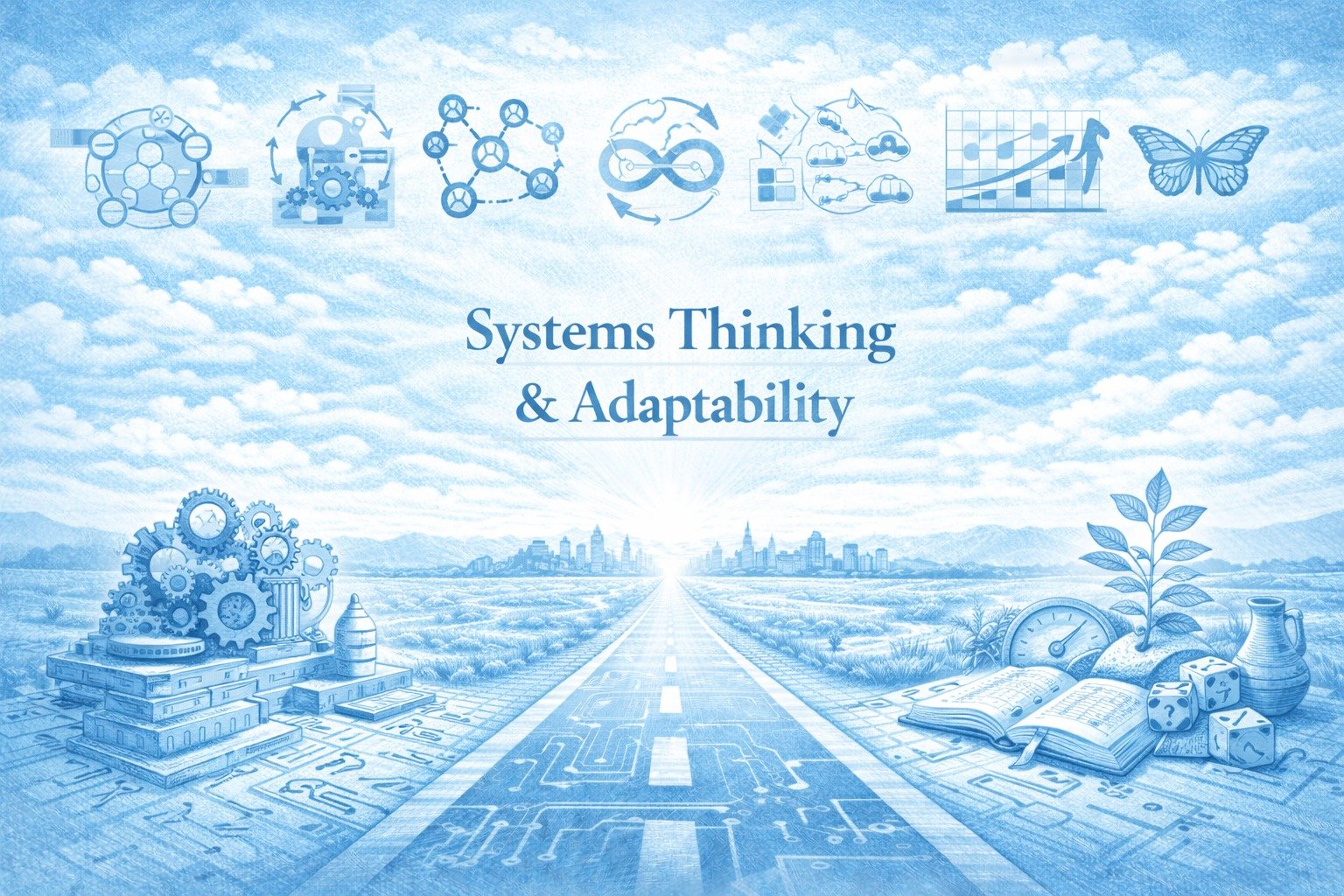
A visual read of how this genre moves from defining the system and understanding its dynamics, through adaptive capacity and leverage, to interventions that remain robust under uncertainty.
Define boundaries, purpose, components, interactions, feedback, dynamics, non-linearity, and emergent behavior.
Build learning, resilience, redundancy, safe-to-fail capacity, and responses that account for uncertainty and trade-offs.
Use leverage points, measurement, governance, and accountable intervention design without hiding behind complexity.