


Meta-Frameworks
& Worldviews.
A structured framework for examining how models define scope, primitives, ontology, causality, evidence, boundaries, incentives, integration, operationalization, and governance without collapsing distinct layers into a single story.
discipline of coherence,
not an assumption.
Integrative models attempt to connect multiple concepts, scales, mechanisms, and perspectives into a coherent architecture without allowing complexity to become an excuse for imprecision.
This genre examines scope, primitives, ontology, causal logic, internal coherence, parsimony, boundary conditions, falsifiability, comparative advantage, operationalization, observability, levels of analysis, integration integrity, incentive realism, misuse risk, and governance of interpretation.
that test the framework.
This genre asks whether an apparently comprehensive framework is actually coherent, testable, operational, and useful, while making its assumptions, boundaries, incentives, and interpretation rules explicit.
What the model claims to cover, and what it explicitly excludes.
Core concepts are defined precisely, without unnecessary overlap.
Agents, incentives, information, institutions, values, and their relationships are distinguished.
Whether the framework explains mechanisms or simply labels categories.
No contradictions across layers, with consistent logic and terminology.
Whether compression loses critical factors or creates blind spots.
Contexts where the model fails or should not be used.
What would disconfirm the model and what evidence it predicts.
What the framework improves over existing approaches beyond simply being “holistic.”
Whether the model can be executed through steps, gates, and outputs.
Which variables are measurable versus inferred, including proxy-failure risk.
Micro, meso, and macro levels remain distinct without unsupported scale jumping.
Whether components truly integrate rather than merely sit beside one another.
Whether manipulation, capture, and adversarial behavior are accounted for.
Whether the framework can be weaponized as a universal justification engine.
Rules that prevent arbitrary interpretation and post-hoc rationalization.
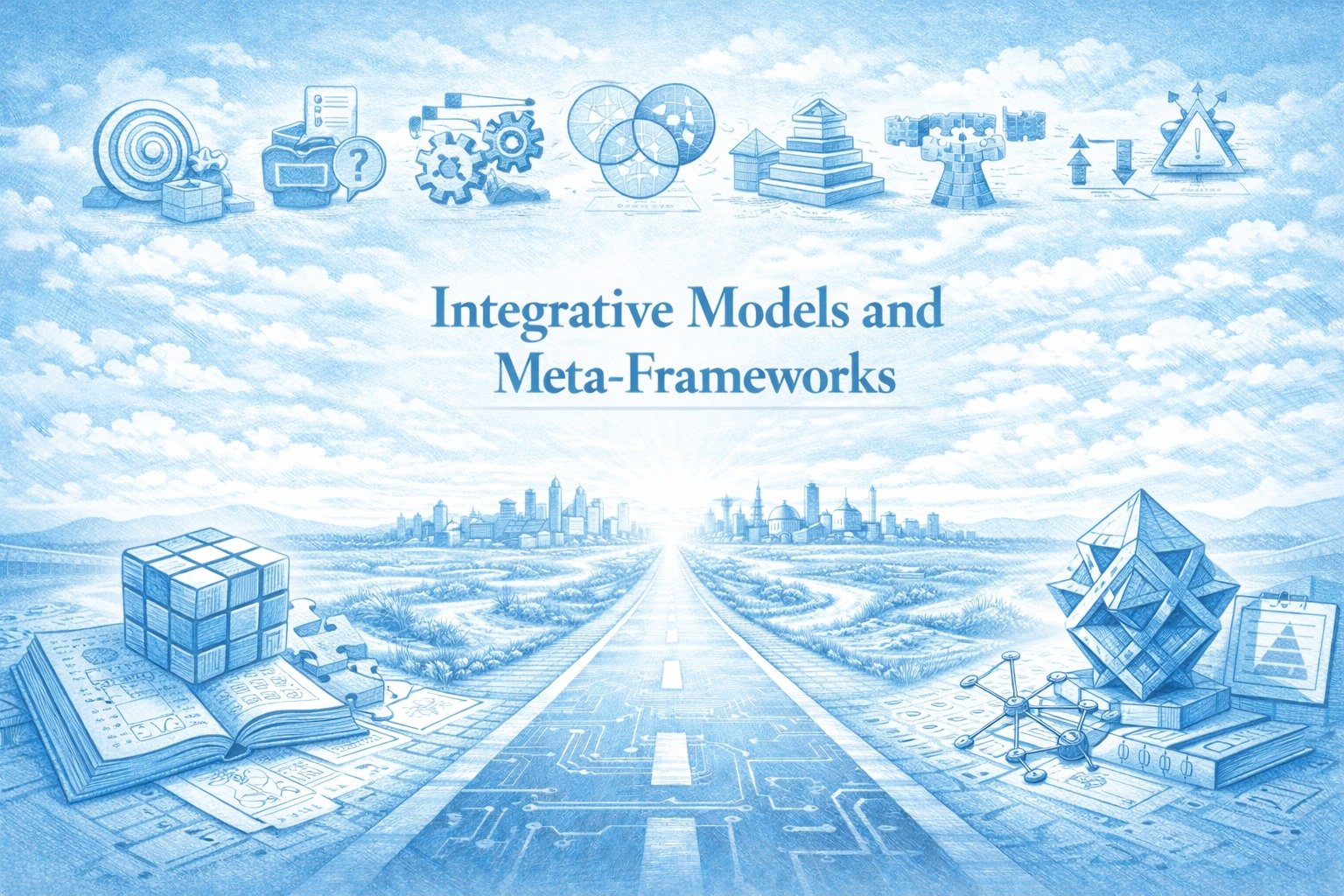
A visual read of how this genre moves from defining the model and its boundaries, through disciplined integration and testing, to operational use with explicit governance over interpretation and misuse.
Define scope, primitives, ontology, causal mechanisms, evidence, boundaries, and the conditions under which the model should be trusted.
Connect scales and components while testing coherence, parsimony, observability, operationalization, and genuine integration.
Constrain incentives, misuse, arbitrary interpretation, and post-hoc rationalization so the framework remains useful in practice.