


Comparative
Philosophies.
A structured inquiry into the responsible interpretation and comparison of Eastern philosophical and contemplative traditions — examining fidelity to source texts and practices, concept translation, mechanisms of benefit, boundary conditions, psychological and ethical risk, authority claims, modern contextual fit, evidence, integration into daily life, and comparative fairness.
fidelity, context
& fairness.
Comparative philosophy becomes more useful when each tradition is first understood on its own terms, rather than flattened into interchangeable concepts, practices, or modern self-help language.
This genre examines source-tradition fidelity, concept translation, claim types, practice definition, mechanisms of benefit, boundary conditions, psychological and ethical risk, authority, modern contextual fit, evidence, daily-life integration, and fair comparison across traditions.
that discipline comparison.
These questions test whether applied guidance remains faithful to the source tradition, translates concepts carefully, distinguishes experience from testable benefit, respects modern context and risk, and compares traditions without cherry-picking or false equivalence.
Is the applied guidance faithful to the source tradition’s intent, constraints, and internal logic?
Are key terms translated without distortion (e.g., “detachment,” “non-attachment,” “desire,” “duty,” “self,” “suffering”)?
Distinguish spiritual/metaphysical claims from psychological practices and ethical guidance.
What exactly is the practice (steps, frequency, conditions), not just the idea?
How the practice is supposed to work (attention, cognition, emotion regulation, community norms).
For whom, when, and under what conditions the practice helps vs harms.
Risks of suppression, dissociation, guilt, or spiritual bypassing.
How teachings can justify passivity, harm tolerance, domination, or avoidance of responsibility.
Whether authority is asserted responsibly (no “appeal to ancientness” as proof).
Compatibility with modern roles (leaders, parents, clinicians, citizens) and constraints.
How practices integrate with daily life without creating contradiction or identity fragmentation.
What is claimed as experiential truth vs empirically testable benefit.
If comparing traditions, avoid cherry-picking and false equivalence; preserve distinct aims.
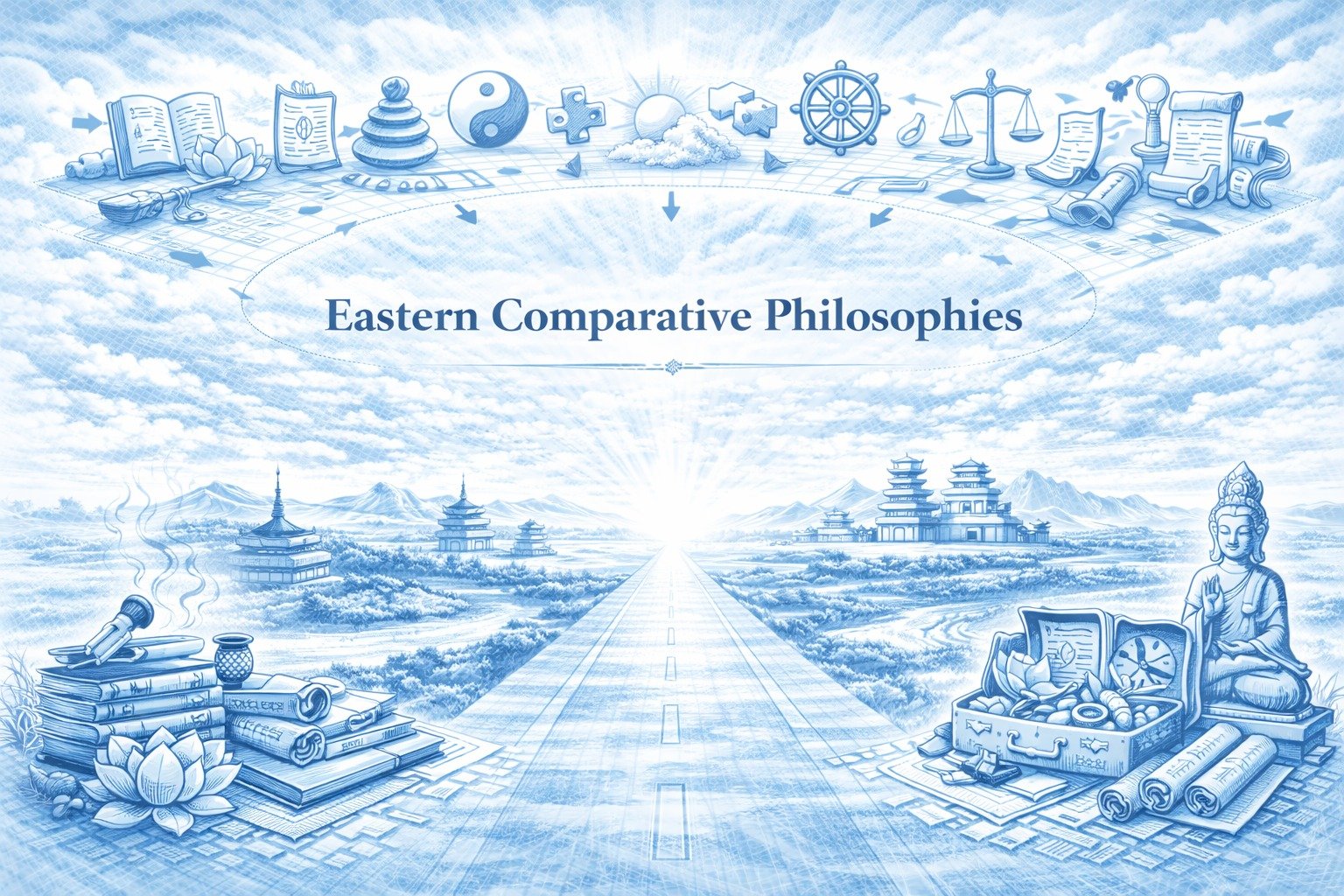
A visual grouping of this page’s Eastern comparative philosophy questions — not a claim of a formal Nous Sapient model.
Establish the source tradition’s intent, concepts, practices, authority, internal logic, and conditions of application.
Carry concepts and practices into modern contexts without distortion, while testing mechanism, evidence, integration, and risk.
Compare traditions symmetrically, preserve distinct aims, avoid false equivalence, and make interpretive limits explicit.