


Philosophy
& Political Order.
A structured framework for examining legitimacy, assumptions about human nature, power, rights, justice, institutions, incentives, coercion, pluralism, stability, failure modes, and the conditions under which political prescriptions remain viable.
system, not a
slogan.
Political philosophy asks not only what a political order should value, but how those values survive contact with power, institutions, incentives, disagreement, and uncertainty.
This genre examines legitimacy criteria, assumptions about human nature and moral agency, models of power, rights and duties, justice mechanisms, institutional design, incentive compatibility, coercion and enforcement, pluralism, stability, failure modes, and the boundary conditions within which political prescriptions remain workable.
that structure the inquiry.
This genre tests political ideas against legitimacy, human behaviour, institutional reality, incentives, enforcement, pluralism, resilience, and predictable modes of failure.
What makes rule legitimate: consent, justice, outcomes, tradition?
What assumptions are made about human nature, rationality, self-interest, and moral agency?
How is power obtained, maintained, constrained, and abused?
What rights exist, whether they are absolute or defeasible, and why?
How is fairness defined and adjudicated through distribution, procedure, and recognition?
What institutions are implied, including the state, courts, markets, and civil society, and how do they function?
Does the system work with real incentives rather than relying on ideal actors?
How are rules enforced, what limits force, and what due process safeguards exist?
How are disagreement, dissent, and minority rights protected?
Does the system remain stable under shocks and evolve without collapse?
Authoritarian drift, capture, tyranny of the majority, and fragmentation.
In what contexts are a political philosophy's prescriptions unsafe, such as weak institutions, corruption, or polarization?
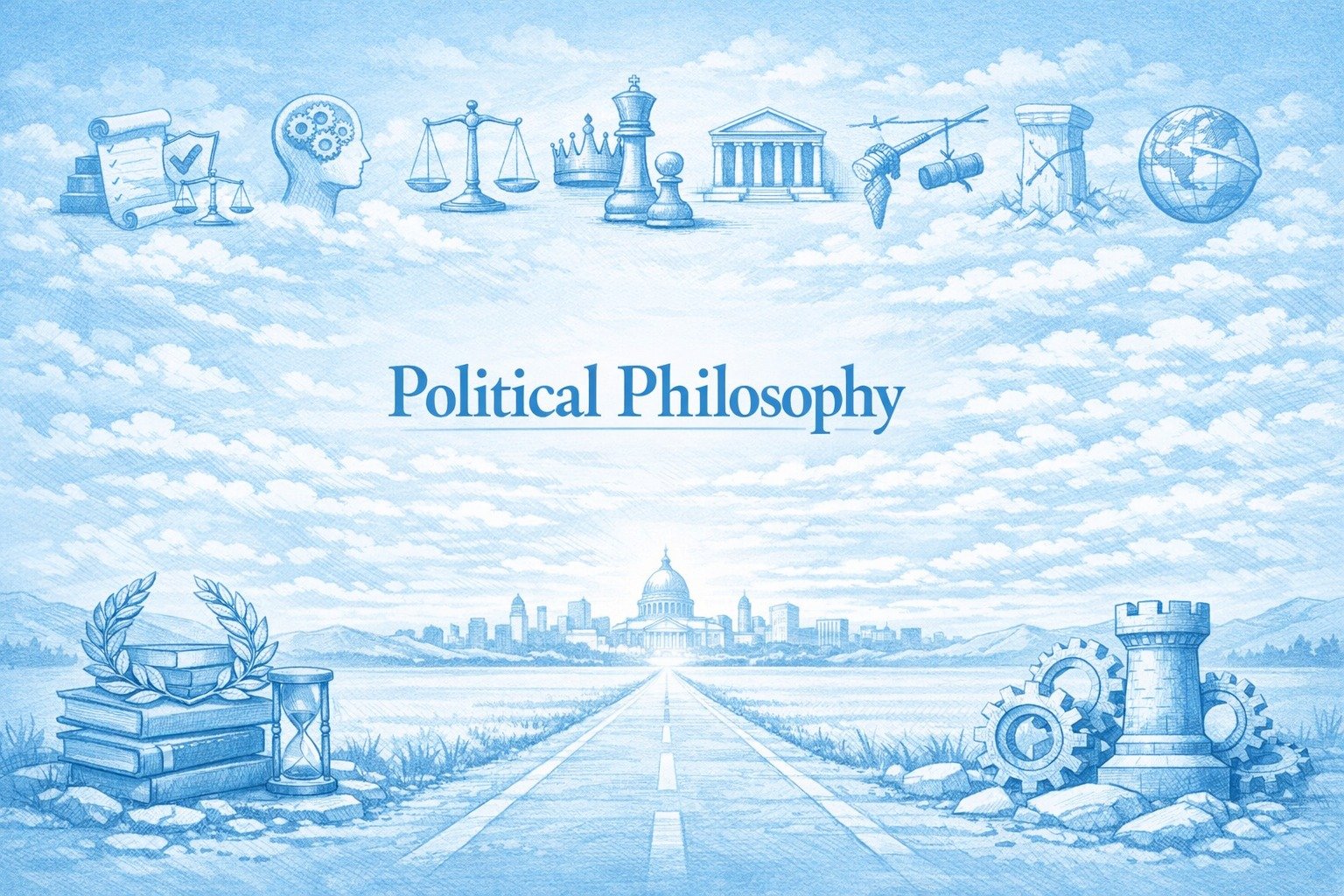
A visual reading of how the questions in this genre move from political principles into institutional reality and finally into tests of stability, adaptability, and failure. It is not presented as a formal Nous Sapient model.
Legitimacy, human nature, power, rights, and justice establish what the political order claims to value.
Institutions, incentives, enforcement, and pluralism determine whether those principles can operate in reality.
Adaptability, failure modes, and boundary conditions reveal whether the political order can survive stress.