


as structure.
Units, roles, reporting lines, workflows, incentives, decision rights, coordination, autonomy, scalability, adaptability, and dependencies are examined as parts of an organizational system.
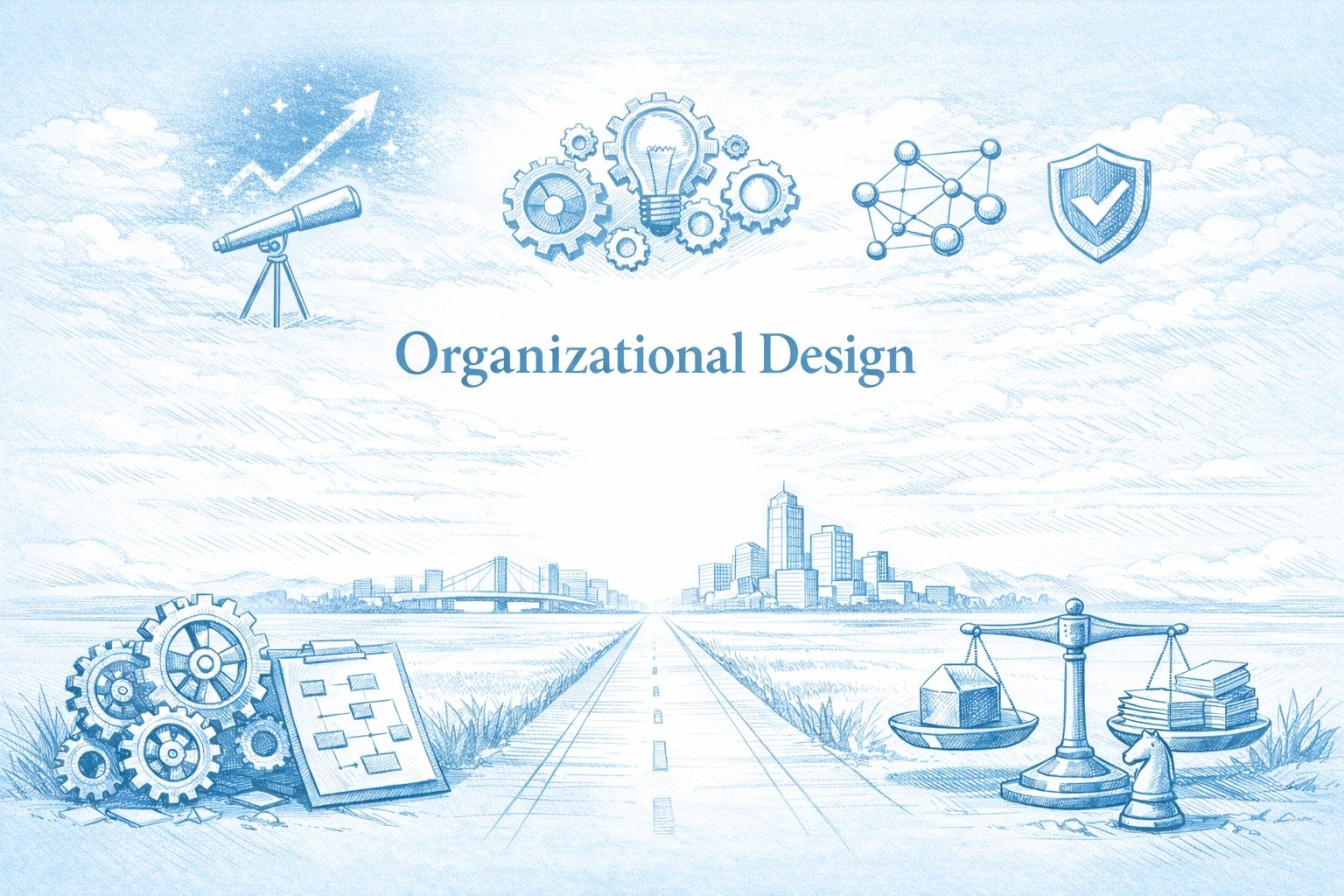
Units, roles, reporting lines, workflows, incentives, and dependencies are examined for coherence.
Organizational Design examines the structural conditions through which work, authority, coordination, and accountability move across an organization.
The inquiry considers decision rights, escalation paths, coordination, control, autonomy, scalability, adaptability, risk containment, cultural compatibility, and failure modes together rather than as isolated variables.
shape the design.
Organizational Design asks how the parts of an organization fit together, how decisions move, and whether the structure can remain coherent as conditions change.
Are units, roles, reporting lines, workflows, incentives, and dependencies coherent?
Are decision rights and escalation paths aligned with responsibility and authority?
How do coordination, control, and autonomy operate together across the organization?
Do workflows and dependencies support effective movement of work across organizational boundaries?
Do incentives reinforce the behaviors and outcomes required by the organizational structure?
Can the structure scale, adapt, contain risk, and remain compatible with its cultural environment?
What structural weaknesses become visible when the organization encounters stress or failure?
What conditions must be satisfied before the organizational design inquiry can be considered complete?
Organizational Design moves from understanding how the organization is structured, through how it decides, toward how it adapts.
Units, roles, workflows, reporting lines, incentives, and dependencies establish the organizational structure.
Decision rights, escalation, coordination, control, and autonomy determine how authority moves through the system.
Scalability, adaptability, risk containment, cultural compatibility, and failure modes complete the inquiry.